
Fields in Crawford County Property Tax Records
Assessment, billing, and recorded transfers live in different Crawford County offices. The Real Property Lister maintains the parcel application the county links to, and the Treasurer keeps tax-billing and collection history open for public inspection. The table maps each question to the right record source. Keep the pieces separate. A parcel result is not a tax bill. A tax bill is not proof of title.
| Field | What It Shows | Where |
|---|---|---|
| Land, improvement, total | Parcel inventory of assessed values; confirm the year and field shown. | Real Property Lister parcel application. |
| Assessment level | Municipal aggregate ratio and equalized value context. | Wisconsin Department of Revenue reports. |
| Tax bill and collections | Billing and collection history for a parcel and year. | County Treasurer or county parcel application. |
| Levy and tax district | Local taxing bodies and the parcel’s share of the levy. | Tax record and municipal billing sources. |
| Sale consideration | Transfer evidence, not an assessment value. | Recorded deed and Real Estate Transfer Return. |
Crawford County publishes no countywide exemption list and no single public tax-bill search URL. Ask the local assessor or Treasurer instead. Ask about a specific parcel and year. Do not assume an exemption or payment-status field appears in the parcel app. Also remember that an individual assessment can differ from a sale price. It can differ from the equalized value, too. That value is published for a municipality.
Locate a Crawford County Tax Record
The county links its parcel application as the land-record search, and the lookup clues below carry real limits. Not every field is visible in the public view. If the application does not show the tax year or payment history, contact the Treasurer for the public billing record.
| Clue | Record role | Access route |
|---|---|---|
| Address or situs | Locate the parcel record. | County parcel application; exact label unconfirmed. |
| Owner name | Find the parcel when its address is uncertain. | County application; matching rules unconfirmed. |
| Parcel or PIN | Identify the tax parcel across records and years. | Parcel application or Treasurer request. |
| Tax year | Set the period for a bill-history question. | Ask the Treasurer if no year control appears. |
Request a Crawford County Tax Bill
The Crawford County Treasurer administers property-tax law, collects taxes, and keeps tax-billing and collection history open for public inspection. The Treasurer's page offers no public bill-search URL. Start with the county parcel result to pull the parcel number and tax district. Then ask the Treasurer for the billing record by parcel and year. An address helps locate the parcel, but a parcel number makes the request precise.
- Find the parcel and municipality in the Real Estate Tax Parcel application.
- Write down the parcel number, tax district, owner name, and tax year in question.
- Use the Treasurer’s public billing-history access or ask the office for the record.
- Compare the bill with the assessment record and any local levy detail.
- Assessed value
- The parcel valuation used in the assessment roll, subject to state valuation rules.
- Levy
- The amount raised by taxing bodies and apportioned across taxable property.
- Equalized value
- A state measure used to compare a municipality’s aggregate assessment level.
- Tax history
- Billing and collection entries held by the Treasurer for public inspection.
Crawford County Tax Billing History
The Treasurer's page states that tax-billing and collection history is public. No separate searchable bill portal exists. A parcel-specific request is the clearest route. Provide the PIN, situs address, municipality, owner name if known, and the tax-year range. Ask whether the record is open for inspection. Ask whether copies carry a charge, and whether an electronic format is available.
The Treasurer's office sits at 225 N Beaumont Road in Prairie du Chien. Hours are weekdays from 8:00 a.m. to 4:30 p.m. A written request can invoke Wisconsin Public Records Law. For a complex search, name the record and date range. That helps staff locate the right file.
Open the Crawford County Treasurer's official record page before making a request.
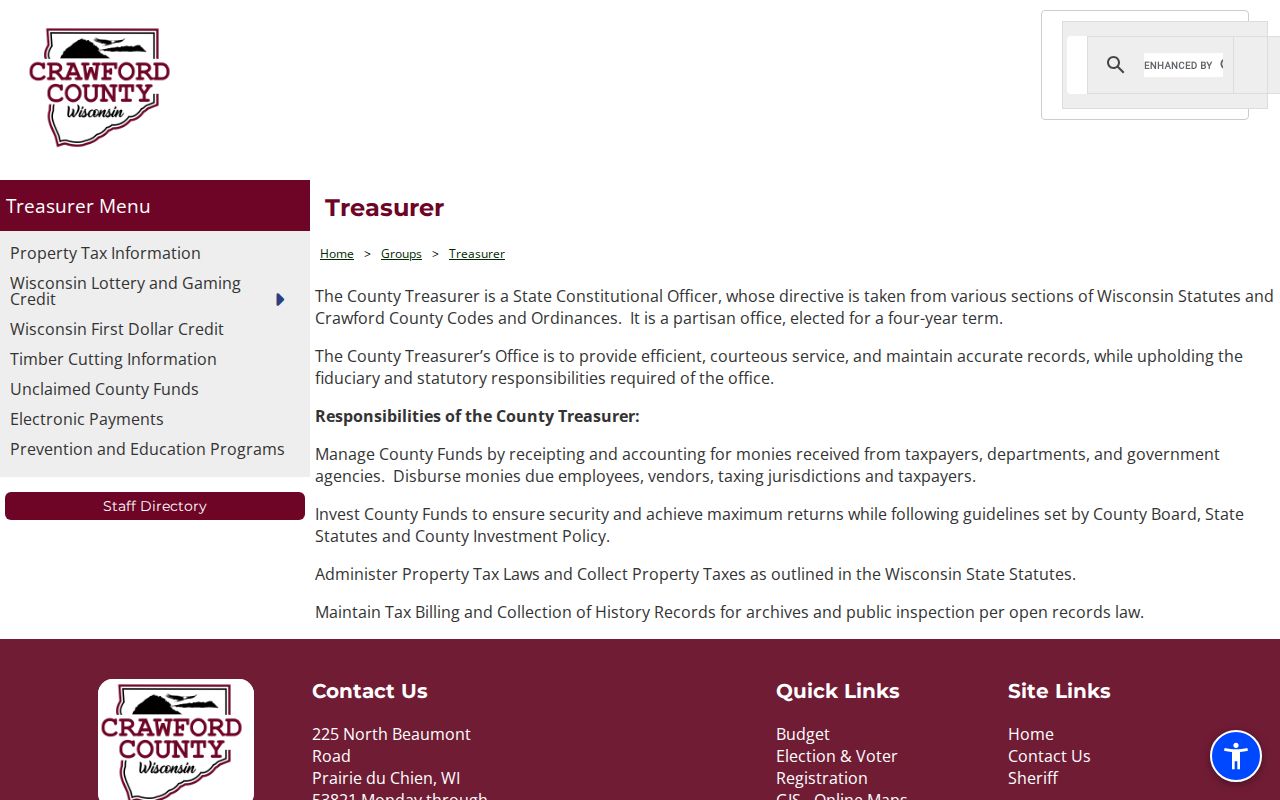
The official Treasurer page is an access route, not a bill itself. Use the parcel number and year to request the underlying billing history.
Compare Crawford Assessments with Wisconsin DOR Ratios
Wisconsin's Department of Revenue publishes municipal aggregate ratios and equalized values each year. An assessment-to-sales ratio compares assessed values with verified sales for a given class and municipality. The DOR also explains a simple method. Equalized value can be estimated by dividing assessed value by the assessment ratio. Treat that as an aggregate comparison tool. It is not a market estimate for one Crawford County parcel.
The state report list is the strongest source for comparing municipal assessment levels. It can explain why one municipality's tax roll sits above or below another's. Still, it is not a parcel appraisal.
See the Wisconsin DOR assessment-ratio reports for the aggregate tables.
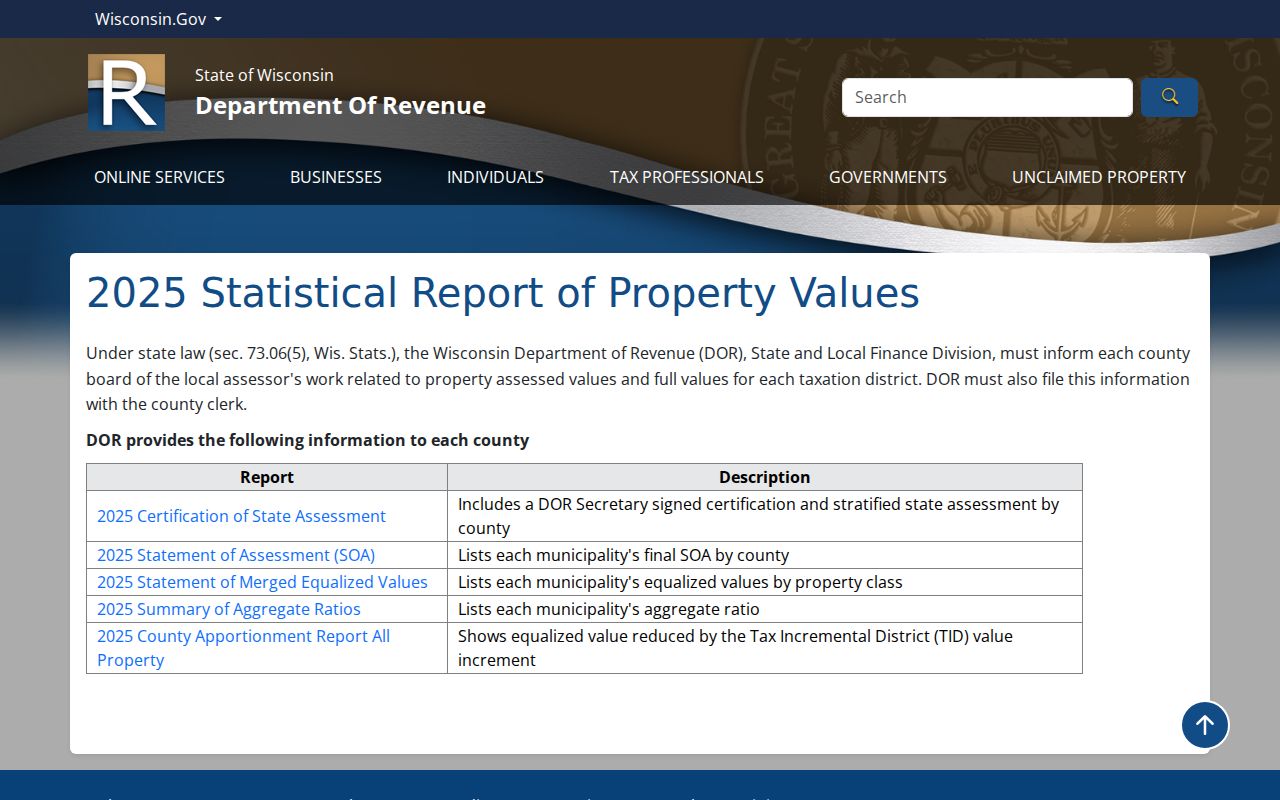
Use the DOR table for municipal context. Then return to the county parcel record for the individual land and improvement values.
When Crawford County Assessment Values Move
Wisconsin Statute §70.32 calls for real property to be valued at full value that could ordinarily be obtained at private sale. A revaluation sets relationships at market value as of January 1. A municipality may not revalue every year, so its assessment level can drift between revaluations. The research did not locate a Crawford Countywide revaluation date or a fixed cycle; use the local assessment notice and assessor contact for the municipality tied to the parcel.
A higher assessment does not by itself tell you that the tax bill rose by the same share. The bill also reflects the property’s portion of the levy and the taxing districts that apply. Compare the assessment, bill, and local levy record as separate documents.
Check Local Tax Districts and Exemptions
Read the parcel and the tax bill side by side. One shows what is taxed. The other shows who owes. A Crawford County bill can stack county, school, municipal, and special levies on a single page. The assessment roll supplies the parcel value underneath those charges. Crawford County publishes no countywide exemption list or single Crawford-specific application procedure. So the local path matters. Ask the municipal assessor which exemptions or classifications fit the parcel. Ask what supporting record each one requires.
A tax reduction cannot be inferred from a sale price, an occupancy change, or a mailing address. If a line on the bill is unclear, the assessor or the Treasurer can identify that record line and its tax year. Keep exemptions, the full bill, and the review process distinct from the assessed-versus-market discussion covered on the property-value page.
Ask About Delinquent Crawford County Taxes
The Crawford County Treasurer holds billing and collection history for every parcel. The county publishes no delinquent-tax list and no current tax-sale page, though. So ask the Treasurer directly. Ask about a parcel's status and the tax year in question instead of trusting a third-party notice. A delinquent bill is one step. A court case, a lis pendens, a sale, and a later deed are separate steps in one record trail.
Put the pieces together when reviewing a property. Compare the tax history against the latest deed and any recorded lien or court filing. A current owner-of-record field on the parcel proves nothing about taxes. It does not show that taxes are paid. Nor does it show that no court matter is pending.
Review a Crawford County Assessment
Begin an assessment review with the notice itself and the municipality named on the parcel. Include the records describing the land and its improvements. The Wisconsin Department of Revenue explains revaluation and assessment levels in general terms. Crawford County publishes no countywide Open Book calendar, Board of Review dates, or appeal form. The municipal assessor or clerk can say which review process applies to the parcel. That person can also explain what evidence must be filed. Bring the sale record and the legal description together. Add the parcel information when discussing any proposed change.
Confirm the local schedule. No countywide deadline was verified in the research. Contact the municipality shown on the parcel promptly for its current Open Book and review dates; do not rely on a date from another Wisconsin community.
Separate the Crawford Tax Roll from the Tax Bill
The county parcel record and a Treasurer billing history answer related but different questions. The parcel roll associates a parcel with an owner name, situs, and assessed fields. The Treasurer’s public billing and collection history addresses charges and payments over a tax year. When reviewing a past amount, keep the year and municipality with the result, because a property’s taxing district affects the levy context and the bill is not simply the assessed value multiplied by one county rate.
Wisconsin assessment law uses full value as of January 1 under Wis. Stat. §70.32. An assessor’s land, improvement, and total values are valuation entries; they are not the bill amount and do not by themselves show whether a payment was made. Equalized values and assessment-to-sales ratios published by the Department of Revenue provide broader comparison context. They can help explain a difference between local rolls, but an aggregate municipal ratio does not estimate the value of one home or establish its tax balance.
For an older bill or collection question, identify the parcel PIN, situs address, taxing municipality, and tax years requested. The Treasurer’s page says billing and collection history is public, but the reviewed materials did not establish a dedicated searchable bill database or the retention period for every record. Ask whether the requested years are available for inspection and whether copies or a particular format carry a fee. A date range and specific record description can make the request easier to route.
Exemptions and appeal procedure require parcel-specific confirmation. The research did not locate a Crawford County exemption list or a countywide appeal calendar. Read the current assessment notice and contact the Real Property Lister or the local board identified for that assessment; do not rely on a date copied from another municipality. If a value is disputed, ask which open-book or Board of Review process applies and what filing instructions accompany the notice. The state ratio report is useful evidence for context, but it does not replace the local appeal process.